

Reaktion Academy
Customer Journey Module in Reaktion
The customer journey refers to the complete sum of experiences that customers go through when interacting with a company and its products or services. It encompasses all touch points a customer has with a brand, from the initial awareness stage, through the purchasing decision, and post-purchase interactions.
Understanding the customer journey is crucial for marketers as it allows them to map out and optimise every step of the process to ensure a seamless and satisfying experience for customers. By analysing each touchpoint, marketers can identify pain points, opportunities for improvement, and moments where they can deliver value or influence customer decisions.
In Reaktion, we have a dedicated Customer Journey dashboard that helps you understand the journey customers take right from the first click until the final purchase. We employ various tracking mechanisms including UTM parameters, Medium, click-IDs, and integrate data from third-party sources such as Shopify to classify the customer journey spanning the 30 days preceding a purchase.
To ensure that you get a complete customer journey, the configuration of correct UTM sources on all your paid traffic is essential.
Here is an overview of the data that you can obtain from Reaktion’s Customer Journey module. You can access the Customer Journey Dashboard in Reaktion here.
Always ensure that you have selected the right date range and webshop(s) if you would like shop level data –
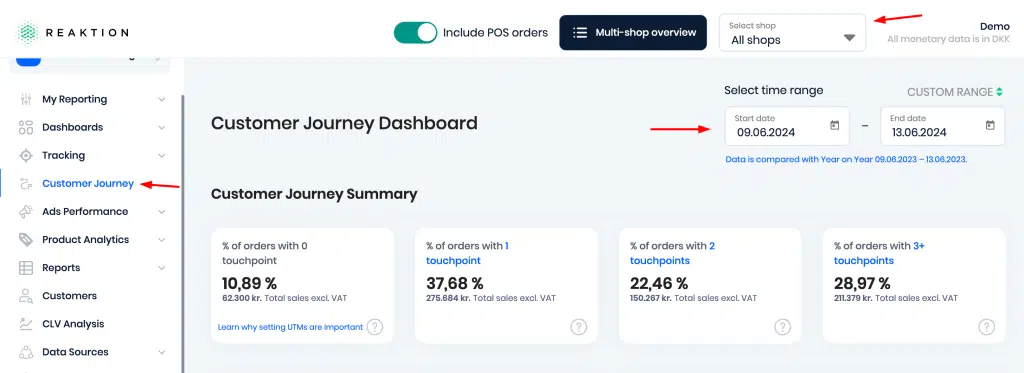
Let us go through the various sections on the Dashboard-
Customer Journey Summary – This section gives you an overall summary of the percentage of orders with touch points. You can view the numbers for the “Total Sales excluding VAT” metric on the tiles.
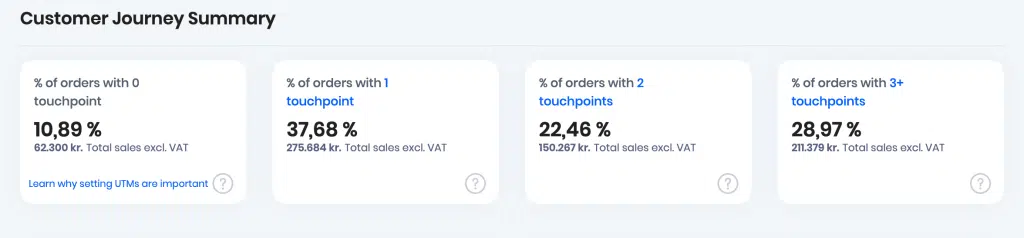
% of orders with 0 touch points – Orders without touch points can be caused by direct traffic, organic traffic, or traffic without click-IDs or UTM sources.
% of orders with 1 touch point – this refers to those orders where only one marketing channel has been responsible for the sale.
% of orders with 2 touch points – this refers to those orders where only one or two marketing channels have been responsible for the sale. In some cases, it could also be two touch points from the same marketing channel.
% of orders with 3+ touch points – this refers to those orders where multiple marketing channels have been responsible for the sale. In some cases, one or all touch points could be from the same marketing channel.
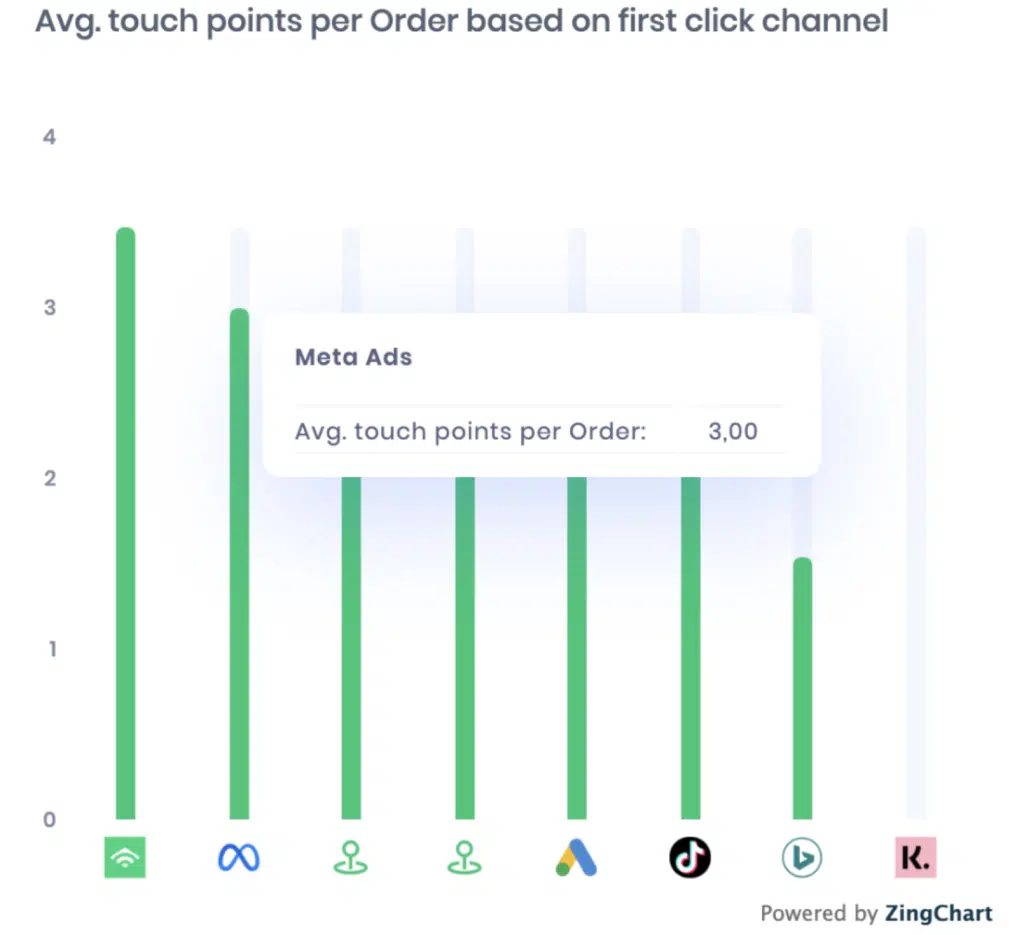
Avg. touch points per Order based on first click channel – this gives you a graph view of the number of average touch points per Order from the channel the customer first clicked on for the defined time period.
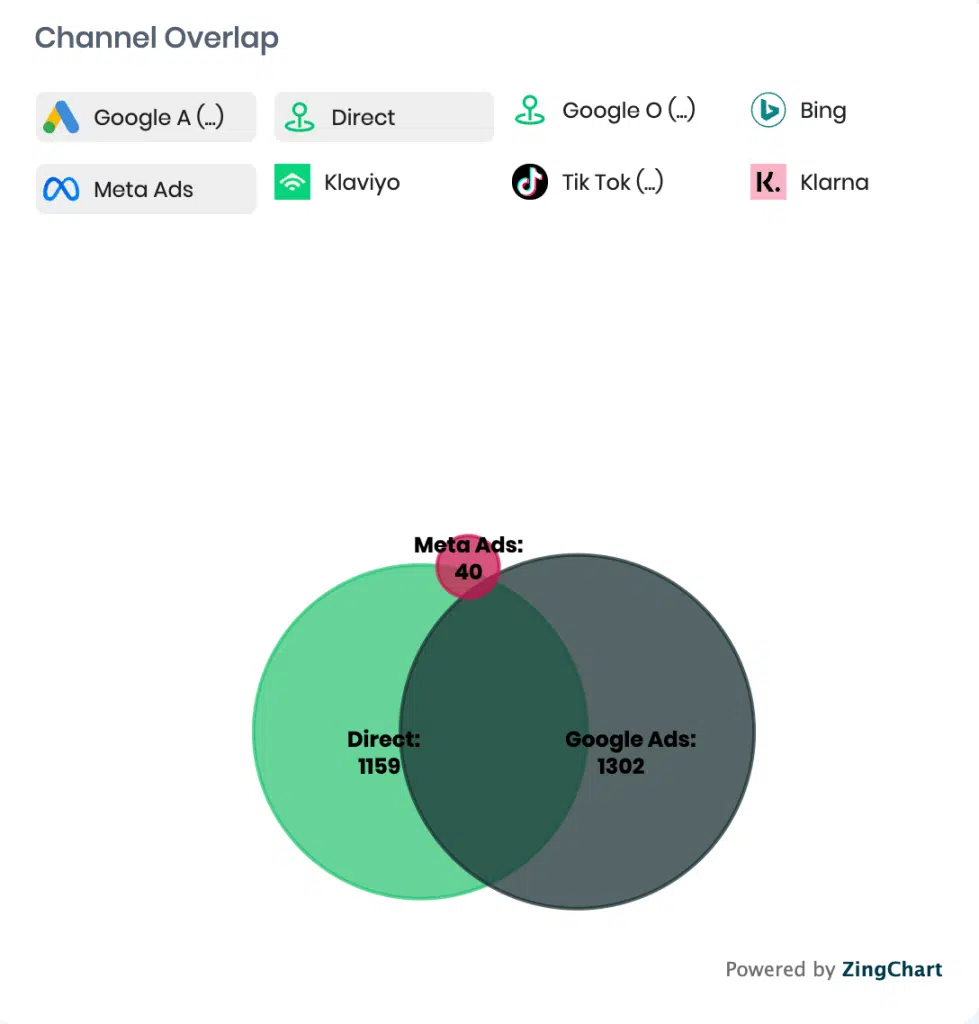
Channel Overlap – If you have multiple marketing channels, there are high chances that some orders might have an overlap in the number of orders. You can select up to three desired channels to see the overlap numbers in this tile.
Customer Journey – This is the section that gives you a full picture of the customer journey with intensive details into the number of touch points, the time between stages/touch points, number of clicks and order details.
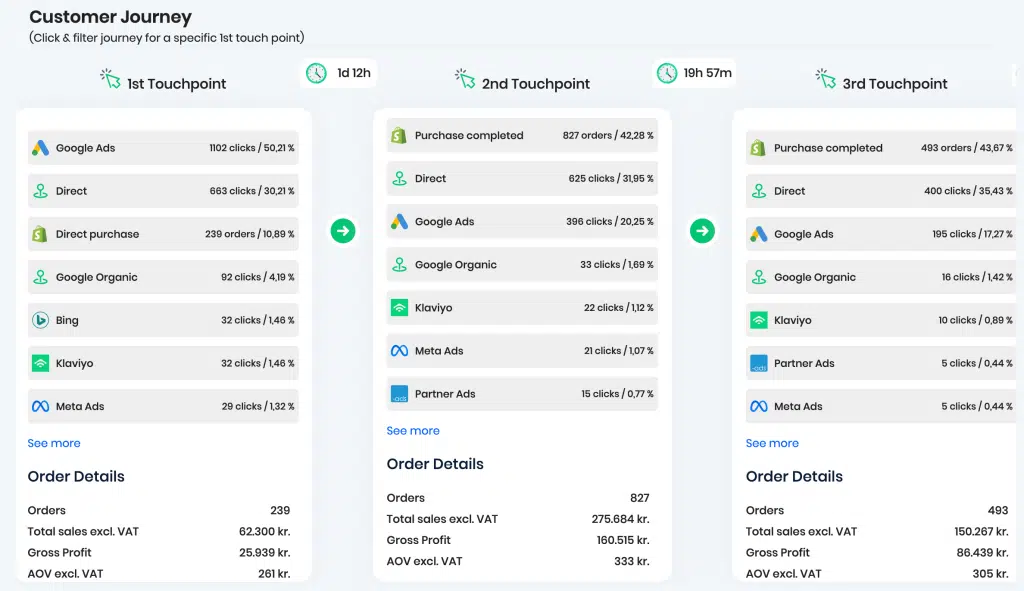
You can click on any of the channels within the touch point stages to get detailed insights into the orders from a specific channel.
Please note that you can scroll horizontally to view more touch point stages.
Touch point channel distribution at each stage – this section can be used to view the distribution of the average touch points per Order based on the first click channel. You can filter this graph by viewing Customer Journeys from one to ten touch points.

Hovering over the graph over any channel would also show you the total number of clicks.
The last two sections in the Dashboard give you a summary of the Customer Journey for Google and Meta Ads. Based on the date range that is selected, you can see the following metrics – Average touch points per Order (First Click Google Ads/First Click Meta Ads), the percentage of Last click orders and the percentage of Assisted Conversions.
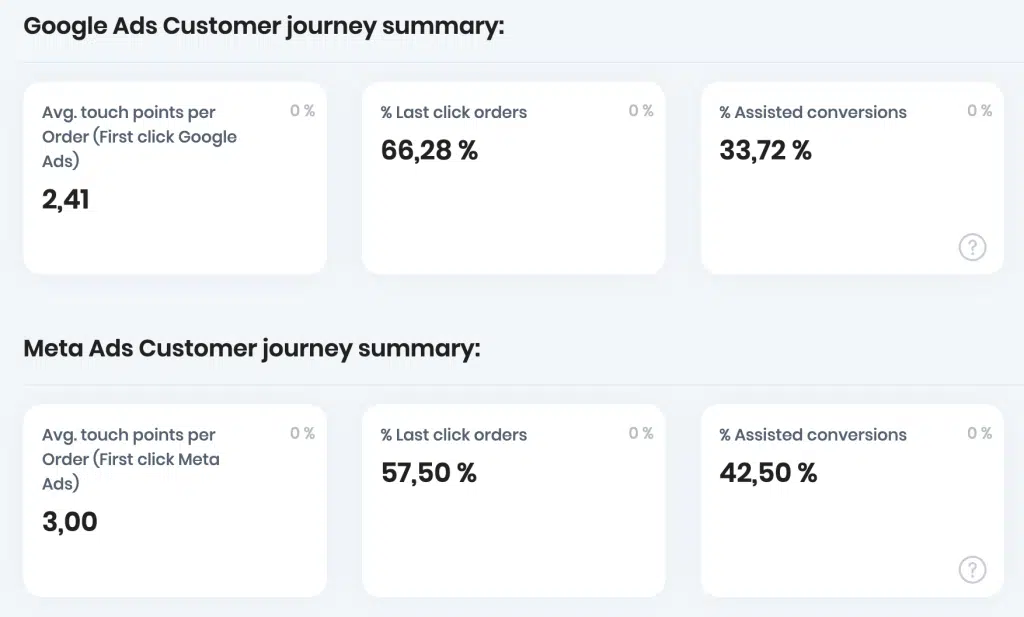
Assisted conversions refer to any conversions in which a particular channel played a contributing role, even though it was not the final channel with which users engaged before completing the conversion.
Why a customer journey analytics tool is a must-have for all ecommerce owners and agencies
In the dynamic landscape of e-commerce, understanding the intricacies of customer behavior is paramount to success. A customer journey analytics tool stands as an indispensable asset for both e-commerce owners and agencies navigating this digital realm. Such a tool serves as a guiding light, illuminating the path that customers take from initial interaction to conversion and beyond.
At its core, e-commerce thrives on the interaction between customers and digital platforms. Each click, scroll, and purchase represents a piece of valuable data that, when pieced together, forms a comprehensive narrative—the customer journey. By harnessing the power of a customer journey analytics tool, e-commerce owners and agencies gain unparalleled insight into this narrative, uncovering patterns, preferences, and pain points along the way.
One of the most compelling reasons for adopting a customer journey analytics tool lies in its ability to foster a deeper understanding of customer behavior. By tracking and analyzing every touchpoint—from the first visit to the final purchase—owners and agencies can identify key moments of engagement, conversion, and attrition. Armed with this knowledge, they can optimize their digital strategies, tailor marketing efforts, and enhance the overall customer experience.
Moreover, in an era defined by data-driven decision-making, the importance of actionable insights cannot be overstated. A robust customer journey analytics tool empowers e-commerce stakeholders with actionable data, enabling them to make informed decisions that drive growth and profitability. Whether it’s refining website design, fine-tuning marketing campaigns, or personalizing product recommendations, the insights gleaned from such a tool serve as a compass, guiding e-commerce endeavors toward success.
In conclusion, in the ever-evolving landscape of e-commerce, a customer journey analytics tool emerges as a beacon of clarity amidst the digital noise. By illuminating the intricate pathways that customers traverse, it empowers e-commerce owners and agencies to optimize their strategies, elevate the customer experience, and ultimately thrive in the competitive online marketplace. As such, it stands not merely as a “nice-to-have” but as an indispensable asset for any e-commerce endeavor seeking to unlock its full potential.